The Engineering of Human Obsolescence
What social media did to attention, AI is doing to judgement, memory and creativity — and this time the people building it are saying so on the record.
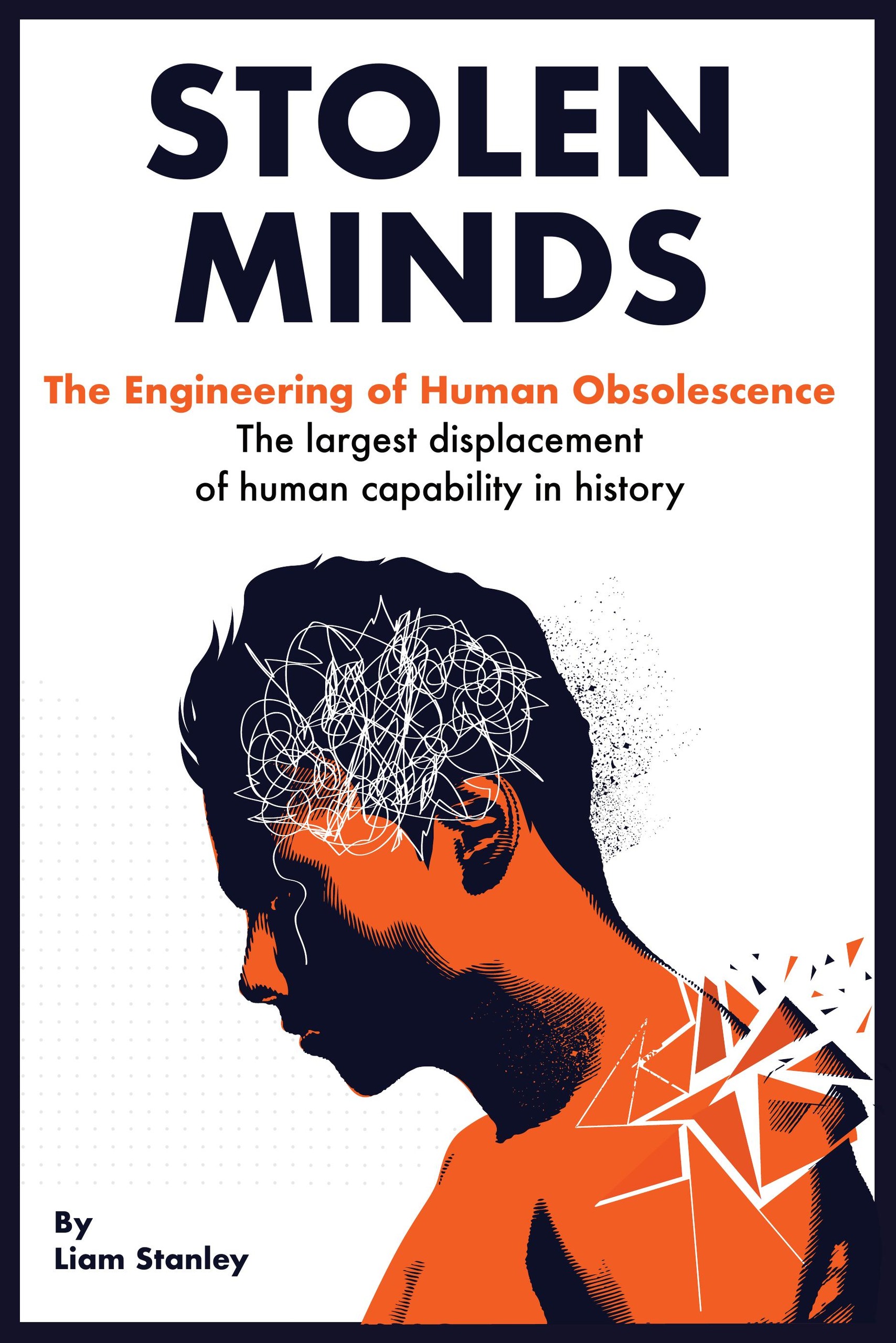
Available now from Amazon in the UK and US. Paperback, Kindle and audiobook.
Prefer a local bookshop? Ask them to order it by ISBN 978-1-83709-676-3. Outside the UK and US, search “Stolen Minds Liam Stanley” in your local Amazon store.
What social media did to attention between 2010 and 2020, AI is doing to judgement, memory and creativity between 2025 and 2030 — and this time the architects are saying so on the record.
We are five years into a second wave. The first — engagement-maximised social media — was something its architects later admitted they hadn’t understood. The second is different: the founders of the major AI labs are stating publicly that their systems will substitute for human cognitive labour, and the economic infrastructure to make that substitution rational is being built now. Stolen Minds names what is being built, by whom, on the public record — and what you can do to protect the cognitive capacities the system is calibrated to replace.
The book identifies three layers of planned human obsolescence — coercive, replacement, optimisation — and a closing window in which it can still be resisted. The first half is the investigation. The second half is the prevention manual: opinionated, tested practices for individuals, parents, professionals, citizens and policymakers. Buy the book →
Engagement-maximised platforms spent a decade dismantling the cognitive ground — attention, focus, memory consolidation — that everything else depends on.
Tools now stand in for the functions the broken substrate can no longer perform — memory, creativity, judgement, the formation of a self.
Competitive pressure makes surrender the sensible institutional choice. The professional who keeps an unaided skill is penalised for it.
The opening chapter, in full. It’s 2004, and a researcher is about to discover how long human attention now lasts at a desk.
The full first chapter is yours free — enter your email and it lands in your inbox to read now, no purchase required.
No spam. One fortnightly essay. Unsubscribe anytime.
Part I is the investigation. Part II is the prevention manual. A selection:
Read it before the door closes.
The opening chapter in your inbox, plus a fortnightly essay that keeps the argument current. Then buy whichever format suits you.
No spam. Unsubscribe in one click.