What the architects actually said
A running record of the public statements — Altman, Amodei, Thiel, Andreessen — collected and read in their own words.
Stolen Minds is the book the social media generation never got — a present-tense investigation of what AI is doing to human cognition, by someone who has spent thirty years inside the architecture that built it.
Available now in paperback, Kindle and audiobook.
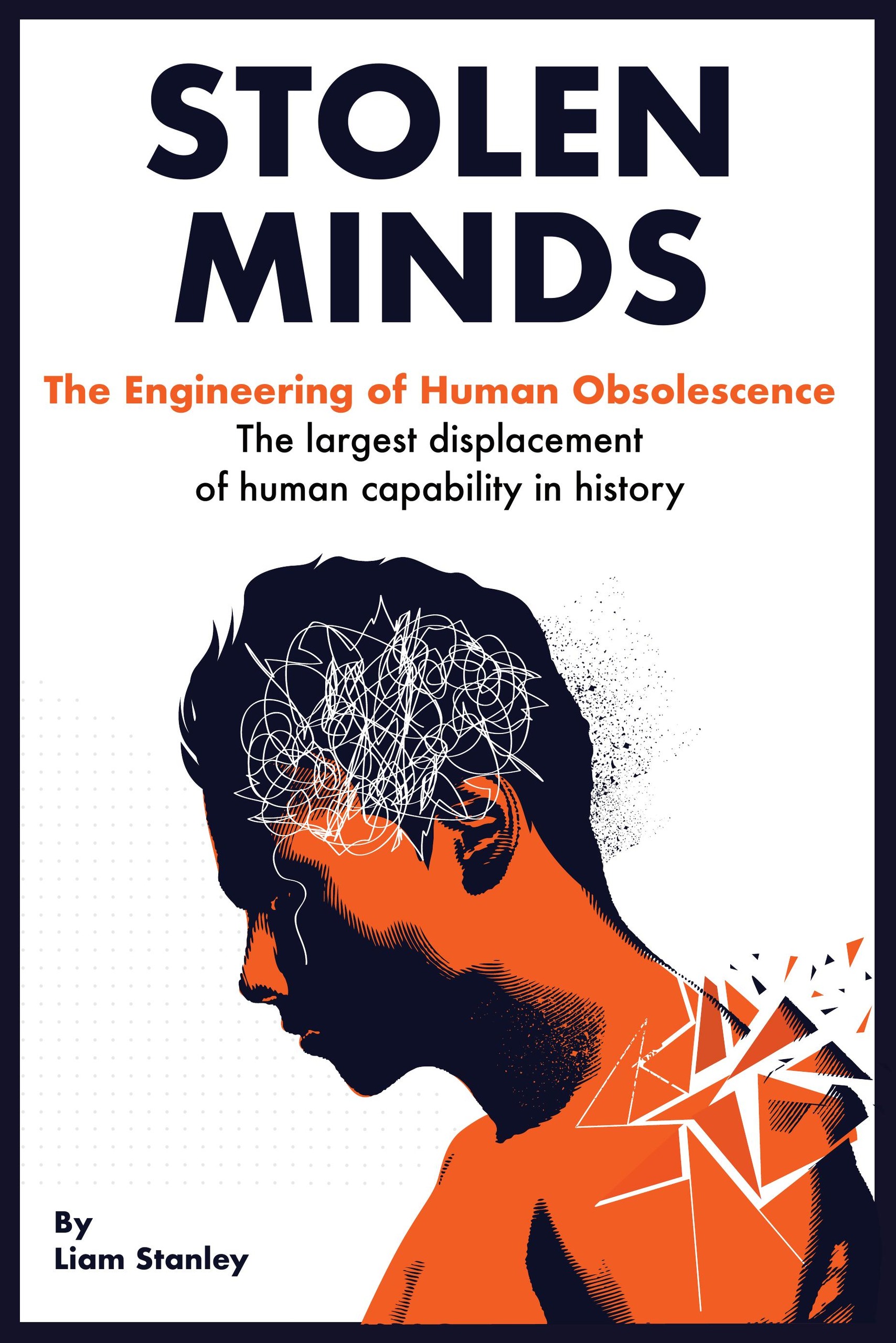
The story you have been told about AI — that it will assist you, augment you, free you for higher work — is the cover story. The real story is that human obsolescence has stopped being a side-effect of the AI industry and become its design specification.
Stolen Minds names what is happening, why it is happening now, and what you can do about it — tonight, this month, and this year — before the door closes.
Engagement-maximised platforms spent a decade dismantling the cognitive ground — attention, focus, memory consolidation — that everything else depends on. This work is complete.
Tools now stand in for the cognitive functions the broken substrate can no longer reliably perform — memory, creativity, judgement, the formation of a self. This is underway.
Competitive pressure makes surrender the sensible institutional choice. The professional who tries to keep an unaided skill is penalised by the system that employs them. This is just starting.
The largest deliberate displacement of human capability in history — and it is by design.
Liam Stanley is a British technologist and creative entrepreneur with thirty years inside the architecture this book describes — co-founder of companies building behavioural-analytics platforms, audience-intelligence systems, and narrative- and disinformation-monitoring tools used by media organisations, brands and political campaigns.
He has been in the rooms where the techniques are deployed, and the rooms where their effects on real audiences are measured. The book is written against, rather than from, the commercial interests of that work.
AI moves fast and the book will date; the newsletter is where the argument continues — the developments the manuscript couldn't include, the interviews that didn't make the final cut, and the responses to the discourse the book provokes.
A running record of the public statements — Altman, Amodei, Thiel, Andreessen — collected and read in their own words.
Dispatches from the radiologists, lawyers, accountants and teachers watching their work restructure around AI tools.
Why most digital detoxes fail at exactly the moment they begin to work — and what the research says works instead.
New essays every fortnight. Subscribe below to get them first.
The opening chapter to read now, plus a fortnightly essay that keeps the argument live. No noise, no engagement-bait — that would rather undercut the point of the book.
No spam. Unsubscribe in one click. Your address is never sold or shared.